Suspended Between Stories
The stories that once organized our world are flickering. Political landscapes, shifting faster than collective comprehension. Institutions, straining under pressures they were never designed to hold. Technology, changing not just what we do, but how we think, how we create, and how we relate to one another.
We’re suspended between stories – between the world that shaped us and the one that hasn’t arrived. And in that gap, we try to make sense of the noise instead of allowing ourselves to fully feel it.
_
This moment feels like reaching for something familiar and finding it slightly out of place.
Because we don’t have the language for what’s actually happening, we grasp for the nearest available explanation. We blame the news cycle, our phones, our jobs, or each other. We try to medicate the symptoms and call it self-care. We optimize our routines while the ground underneath them shifts.
We are desperately trying to win at a game whose rules are inherently failing.
What makes this moment in time so particularly hard is that we’re all in it, but we’re experiencing it alone. There’s no shared map. There is no agreed-upon story about what this transition means or where it leads.
And humans are, at our core, storytelling beings – we need a story, we need to know we’re somewhere in a narrative…that there is a before, a during, and an after. But when the story fractures, we do something painfully predictable: we make it personal. We turn the spotlight on ourselves – we decide something must be wrong with us, rather than recognizing that our environments are no longer built to support the ways we’ve shifted.
When we make the story personal, it’s easier to dissociate rather than band together. And dissociation comes in many forms. We perform certainty. We argue loudly for positions we’re not so sure we fully believe anymore. We scroll, we try to stay busy, consume more than we can digest – so we don’t have to sit with and feel the full weight of how disorienting it actually is. And so the gap widens.
_
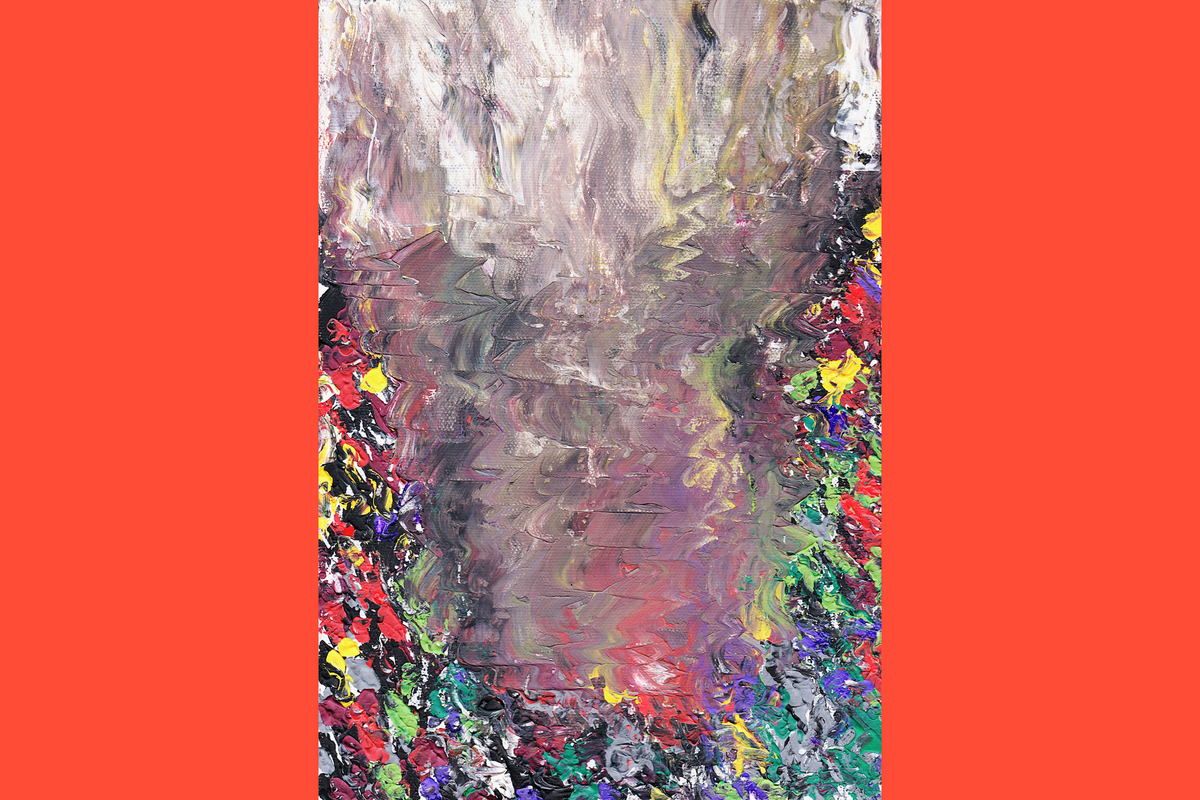
I created this art piece while sitting inside a gap of my own.
My body was tense most days, frustration and resistance kept rising, but I couldn’t yet name what needed to change. The odd thing about outgrowing something is that it rarely announces itself as a clear break. It shows up as discomfort, confusion…a creeping sense that the world you’re standing in no longer holds the same shape it used to.
I kept waiting for clarity to arrive before I allowed myself to move. Kept thinking that if I just figured out the right next step, the tightness would ease. Creating this painting gave me permission to stay in the discomfort. To visualize what was happening internally and really live it.
The dense colours at the edges feel overcrowded; like fragments of everything pressing in from all sides – noise, memory, urgency, expectation. In the centre, everything breaks down. The paint blurs, drags, loses its clarity. Forms appear and dissolve at the same time. Collapse and emergence co-existing.
When multiple stories are trying to emerge simultaneously – when old frequencies are fading out, and new ones are still tuning themselves into existence – it feels just like this. So intense. So contradictory. So overwhelming and disorienting.
The instinct that felt like a firm hand on my back, pushing me forward, was to grab onto the first story that made things feel solid again. To force meaning. To make a decision, any decision, just to escape the sensation of not knowing. The discomfort was relentless. Or maybe it was grief? For the version of my life I was leaving, even though my body very well knew I no longer fit.
_
Feeling – the uncomfortable, sometimes uncontrollable thing we spend most of our lives trying to manage or stop apologising for – is where things shift. And language has always been a lagging indicator – we name things after we’ve already begun to feel them.
If history has taught us anything at all, it is that every time the old narratives have collapsed (and they have collapsed, repeatedly, across every culture and era), humans have eventually, imperfectly, built new ones. Not because someone figured it out or the right person came with all of the answers... But because enough people stopped pretending and conforming to the old shape of the world, and started feeling and bravely holding the discomfort. Noticing what was moving through them and letting that be a new beginning.