
The Choreography of Difference: From the Sidewalk to the Lab to the Studio
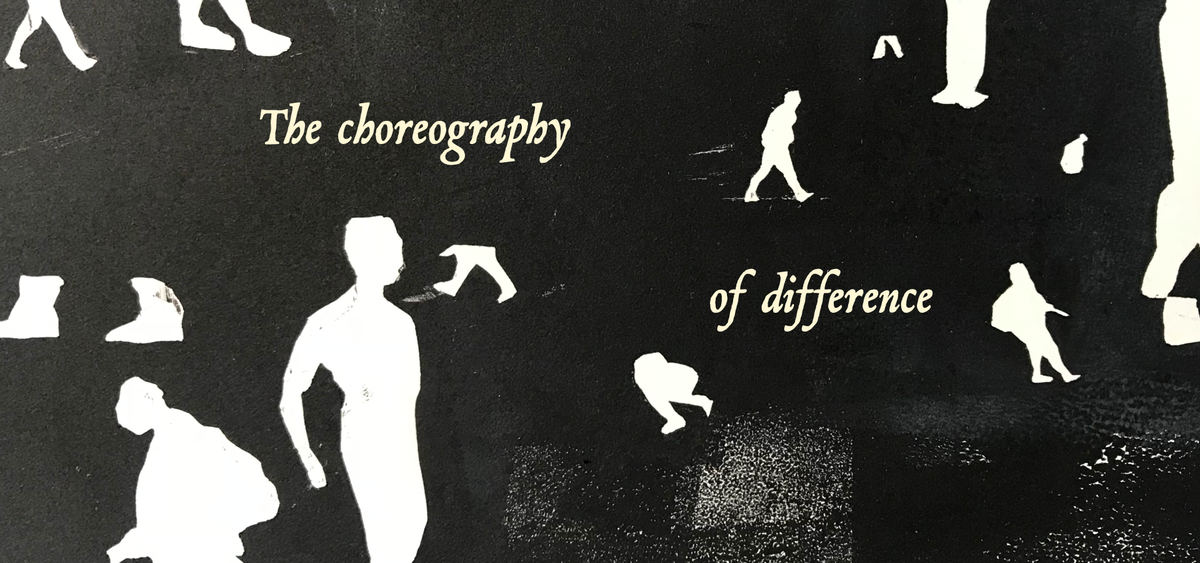
by Sara Dotterer
I have always been drawn to the stories that bodies tell. The way they move, the posture people inhabit, the vibrant nature of a street corner in a big city.
I was an anthropology major and a dancer in college and decided to combine both interests for my thesis in 2017. I spent a winter filming pedestrians (students, teachers, faculty, etc) on my campus, trying to catch personality in the way people walked…
What I'd now call, in the context of this exhibition, someone's particular wiggle: the pop of a hip, the rhythm of their stride, the small idiosyncrasies that make a body, you know, a body.
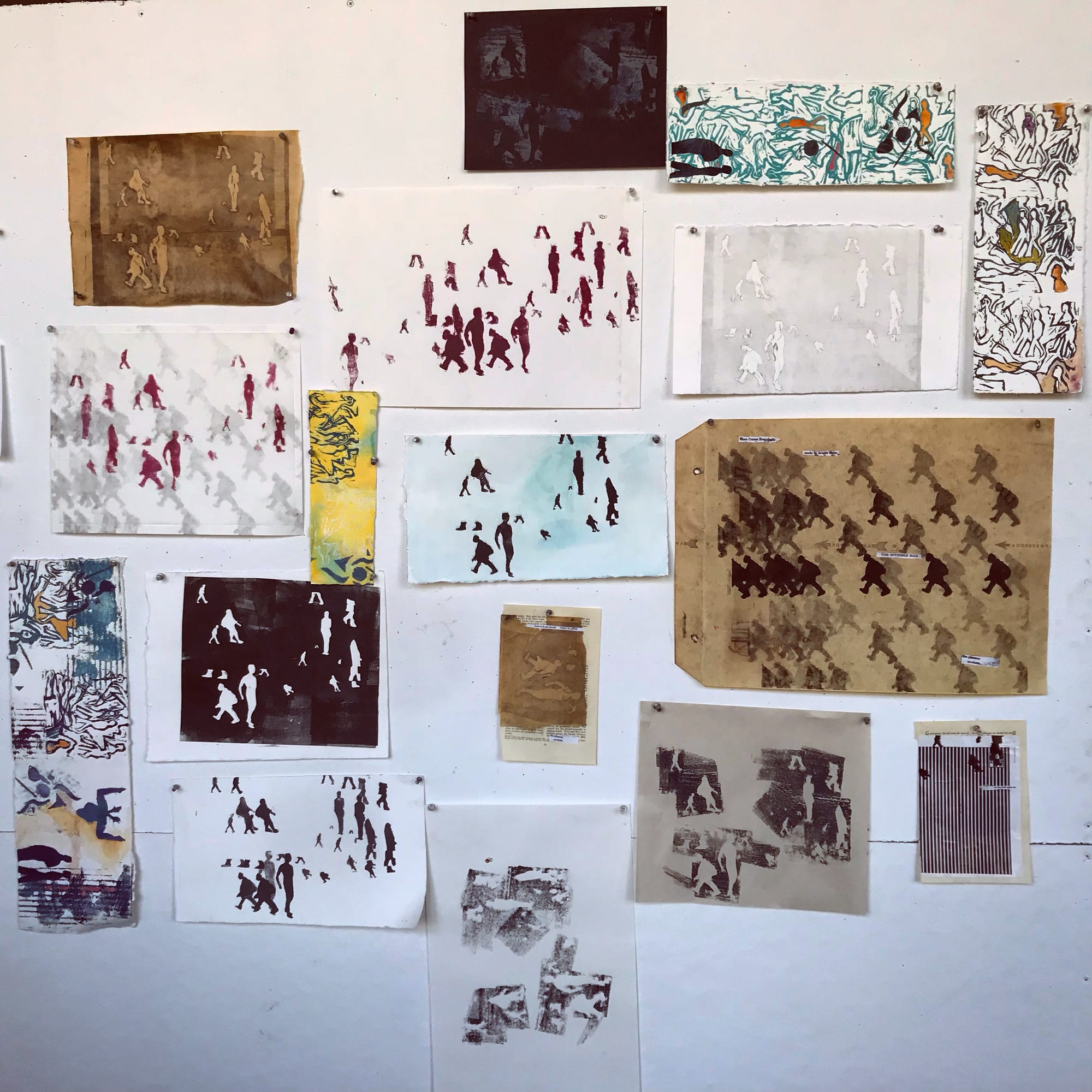
But I quickly realized I was getting the same gesture repeated a couple hundred times: head down, thumbs moving, a slight correction when a foot met grass instead of pavement (or god forbid, another human), head back down. I called the pattern, in the earnest way of a twenty-one-year-old with a thesis to write: the virtual-reality cyclical communication model.
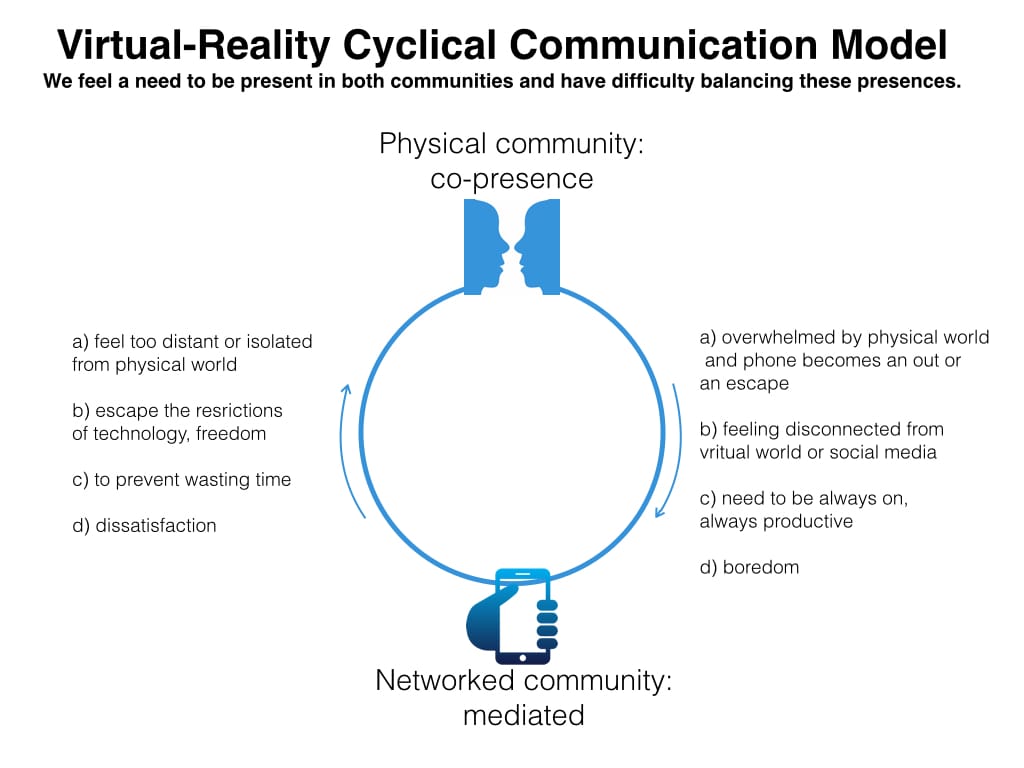
This is a mouthful for something simple: the way humans are constantly shifting between a world mediated by screens and our own physical surroundings. I'd been drawn to studying pedestrians because I loved watching differences collide and adjust on a busy corner. To my naive disappointment, the phone had given everyone the same choreography to perform instead of their own (although I still did document them). I was saddened by the homogenous movement, but also by what it meant on a campus that historically emphasized dialogue and connection.
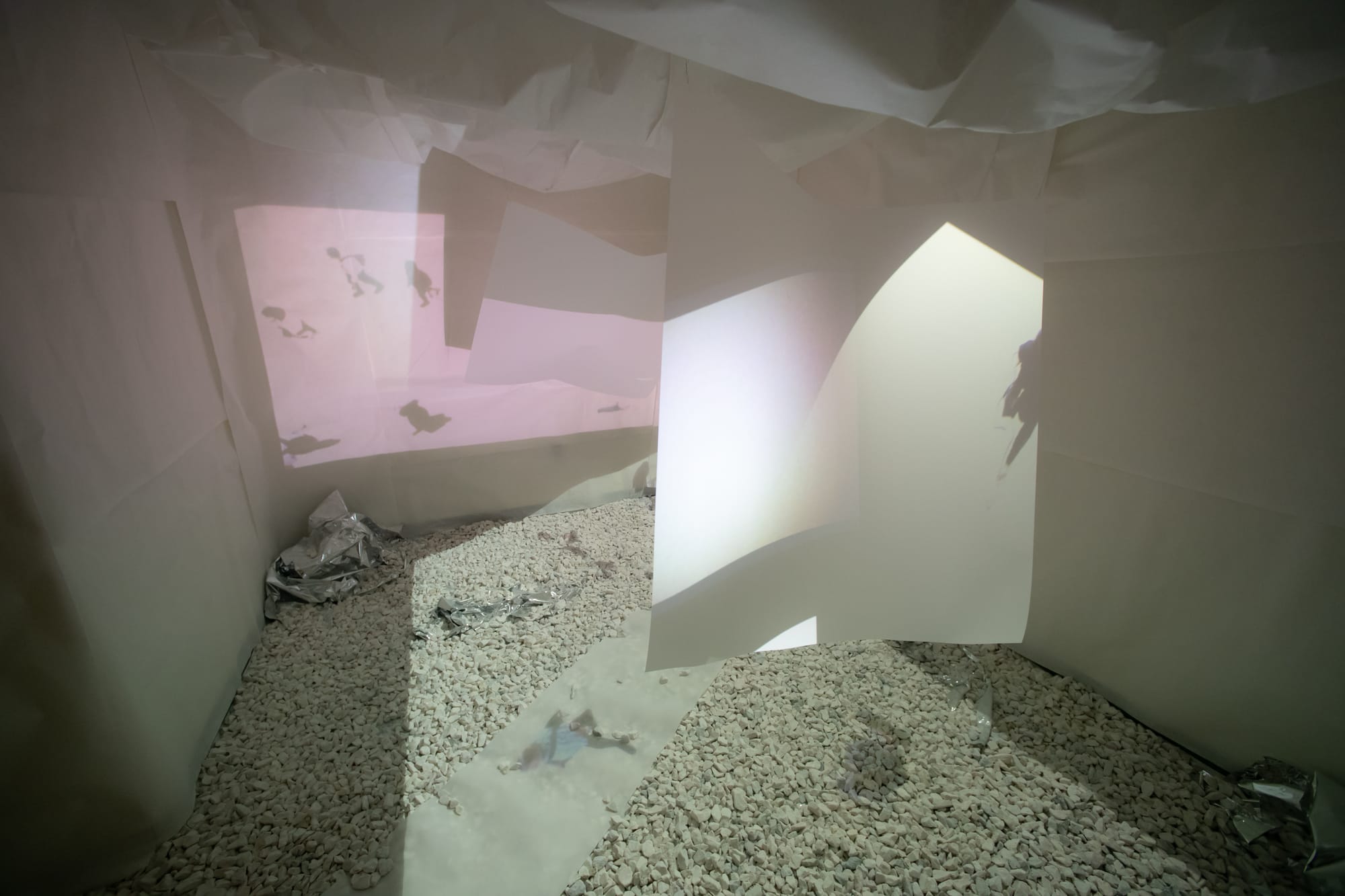
I then went on to create an installation within our University containing footage from my pedestrian videos – but the trick was – when you walked in, you stepped on rocks that were on top of foil and mylar, making every step extremely loud. I wanted people to feel their steps, feel their movements, and be aware of their surroundings (albeit the method was a bit forced). The wall text read:
"walking, a state of being"
Includes: Step, step, look up, look down, look around. Say hello, take out your phone. Make eye contact, not too much. Step, Step.
Walking is the most simplified form of dance. As a dancer and choreographer, I am attuned to the ways in which people move through buildings, on the sidewalk, or down narrow walkways. The wonder of walking is that no moment can be replicated. Each movement is fleeting and forgotten, and often a response to either your physical environment or the people around you. I work in many different mediums, to abstract and replicate moving bodies and create rhythmic spaces. There is beauty not only in walking, but in the way that we view the world while we move and learn with our bodies. This beauty and ability to engage with our environment is often obstructed by technology, and our daily rhythm of movement is dictated by our cell phones. Within this room, I document an experience of being alive in the digital age. I created a fictitious landscape that blends organic and technological elements, a juxtaposition to the rest of Wilson Hall.
I learn through movement, through experiencing, and it is through this interest that I create art. As a child, I preferred to move around without shoes, liking the feeling of the mud, sand, and grass moving through my toes. For me, the natural world is one of the few places that releases me from my devices. For this reason, I chose to transport the entropic world of nature into this small room by covering the floor with rocks; each one is individually created by the natural world, a stark juxtaposition to the calculated, mechanical character of technology. The rocks heighten your awareness and amplify the sound and sensation of walking. Each day we enter the public stage with our phones, and constantly switch our attention between what’s going on around us and our screens. Our phones are windows into different places, people far away, a lens through which we see the world. You are welcome to use your own phone within the space to frame your experience. Marcel Duchamp once said that a work of art is completed by the observer or listener and that is what this piece should be; the interaction of the viewer is the last component of this work that fortunately, I cannot control.
My question to you as you enter: are places and the people within them losing their significance as we become lost within our devices?
In 2021, I got into graduate school for art and became fixated on species beyond human. Nature, of course, does uniqueness or difference really well. Take fractals: tree branches follow a self-similar structure, the same basic pattern repeating from trunk to twig at every scale, but no single repetition ever comes out identical. Mycelium is stranger still: thousands of individual filaments, called hyphae, branch and fuse underground into networks with no center.
Or just go for a walk – do you ever see the same leaf, rock, flower? Look at animals in the wild: A sloth moves slowly. A cheetah moves fast. Each moving at the pace of their unique design and needs.
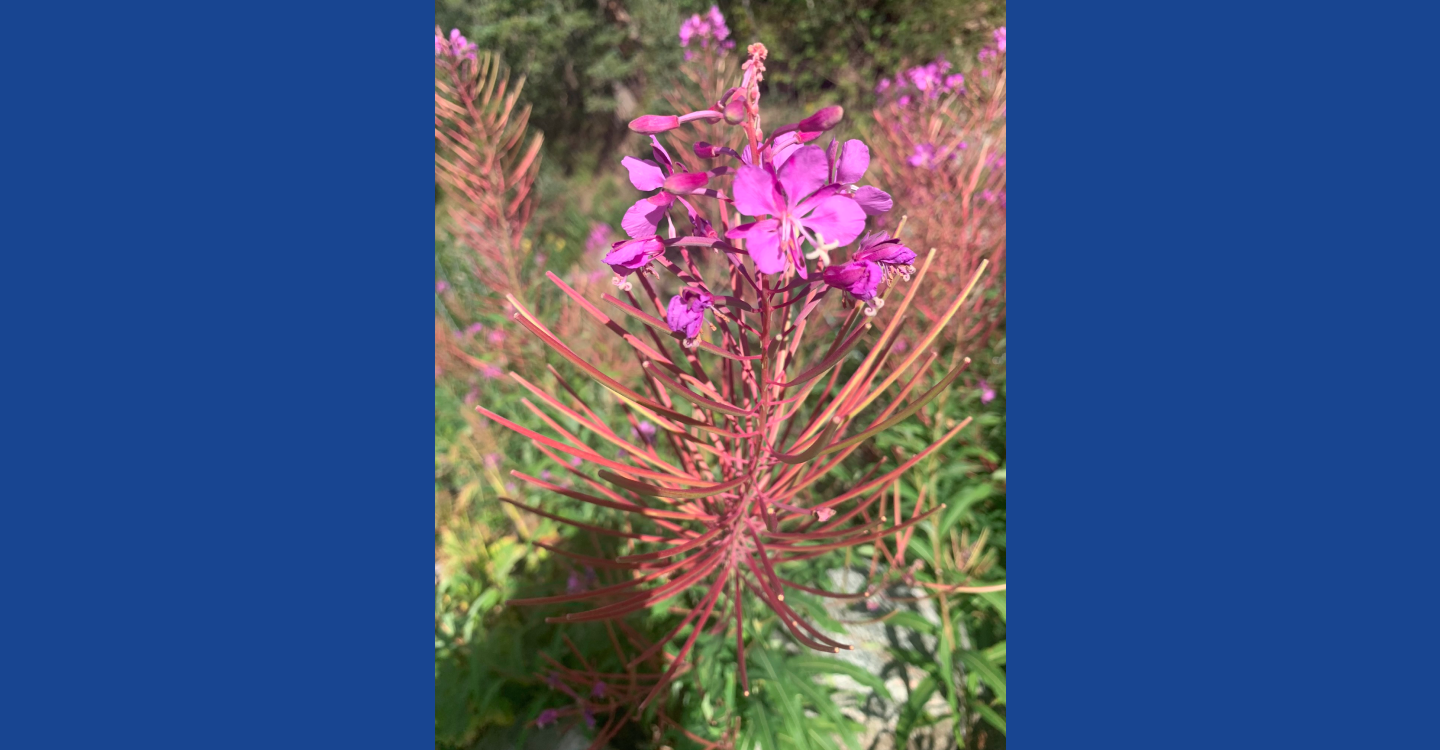
That contrast… between homogeneity and diversity… is what I keep coming back to in my art. A recent installation of mine at Shirley Fiterman Art Center displays two different studies.
For Groundlines, I gathered rocks on walks and hikes through the Hudson Valley, Dallas, Austin, and Virginia: each carrying its own weight and its own history. I wrapped them (an arduous process) in pink fishing line and hung them from the ceiling of the gallery – delicate-looking but strong enough to hold two hundred pounds. Each rock is suspended above cyanotypes I'd made outside with rocks, leaves, bark, and grass. I liked that this heavy piece was suspended above something very fragile and light. Our world can make us feel like we are in a climate doomsday (maybe we are?!), but why not find levity and joy as a counter, for our own sanity, and for the hope of a better, more resilient future?
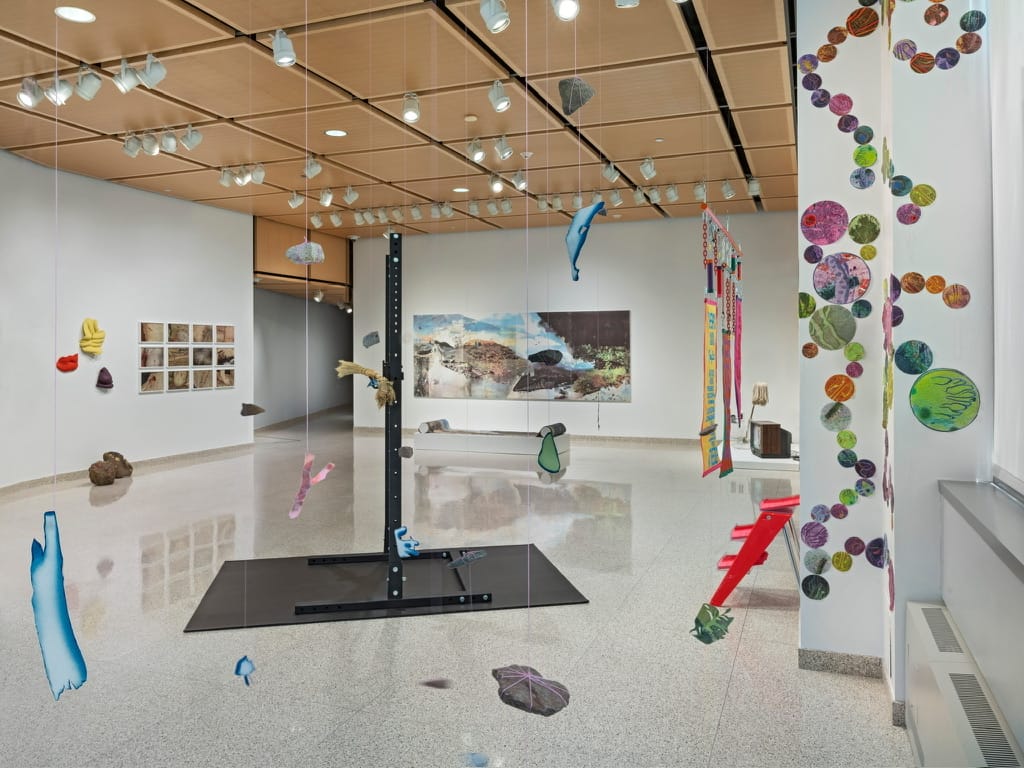
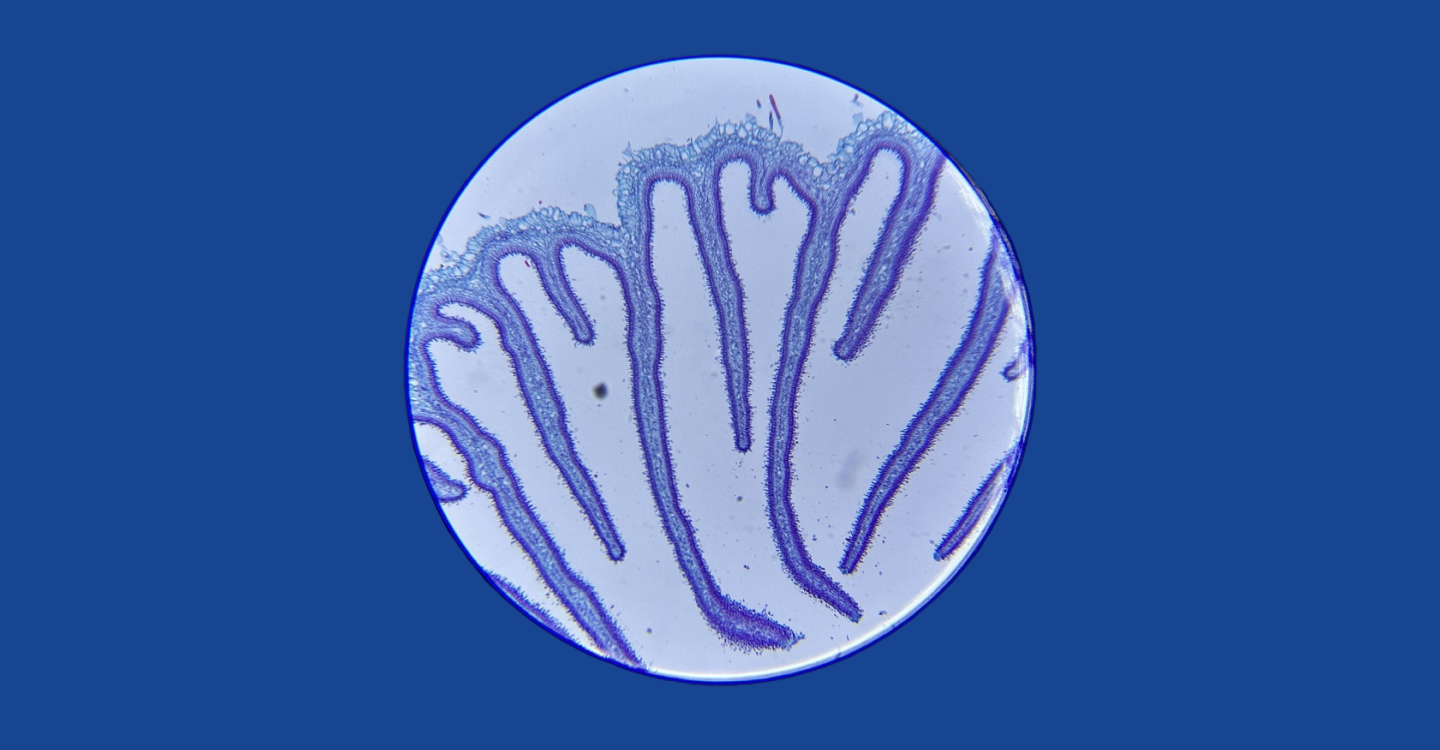
For Cellularlines, I looked at fungal, plant, human, and neural cells under a microscope. I was fascinated by the unique world within each cell.
As a next step in my process, before printing them on fabric, I brightened their colors in Photoshop and then overlaid them until their singularity became nearly indistinguishable. I then stitched the shapes together with colorful threads.
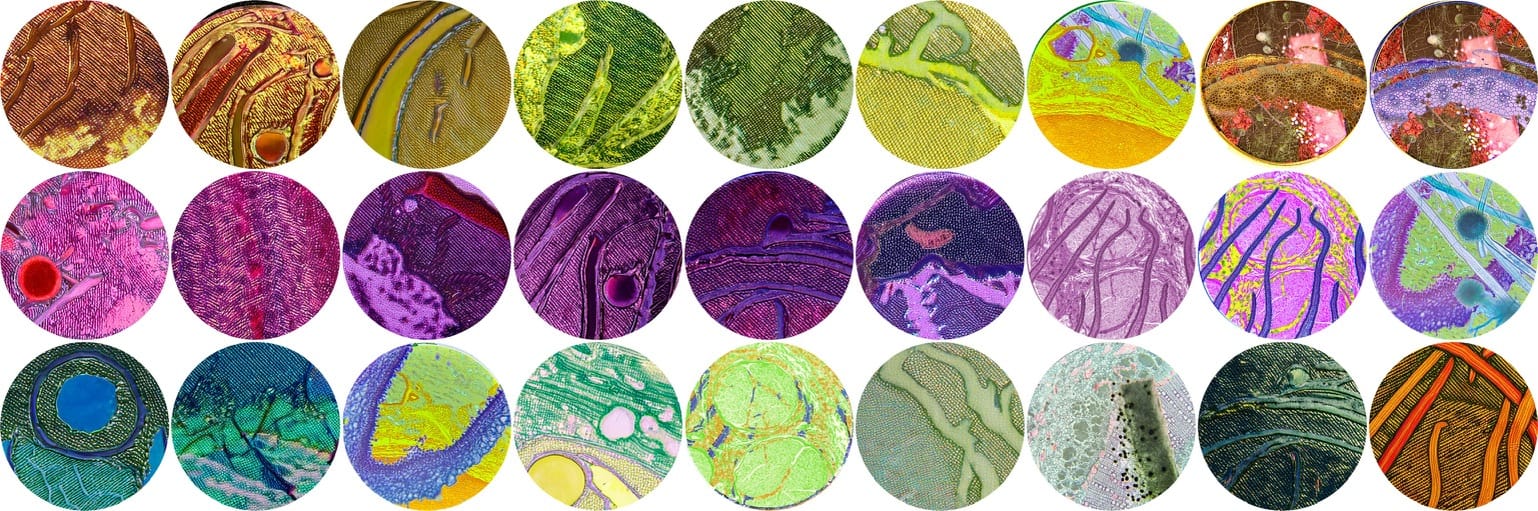
It was an interesting exercise to observe each species’ differences all while acknowledging the similar patterns at the foundational level. When I hung each amalgamation of cells within each fabric circle in the gallery, I saw the oneness that occurs when you zoom out to the macro scale.
Each began to look as much like a cell as a river delta or a mountainscape. That blurred boundary – between diversity and oneness as well as micro and macro – has become a guiding force in my work.
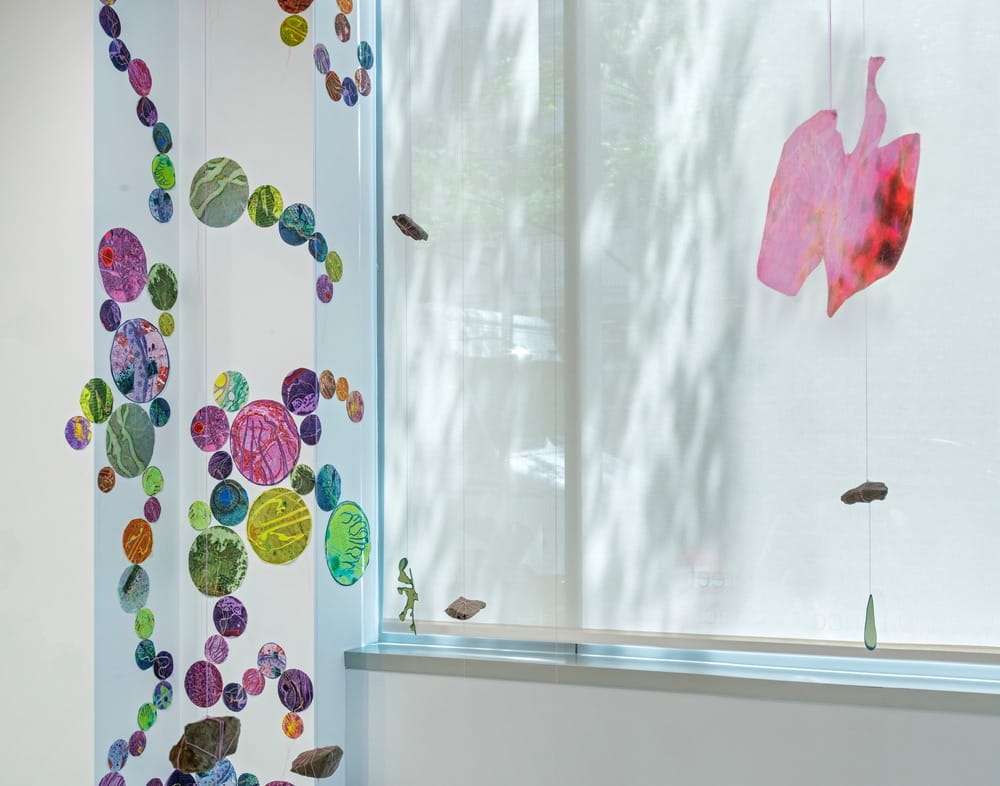
Without these diverse cell structures, I wouldn’t have a rolodex of patterns to draw inspiration from in my art. It’s much different from the phone research from 2017 – where I felt blocked by the homogeneity. There are infinite new shapes and patterns to find in nature, not dissimilar to their actual roles: a mushroom aiding the decomposition of toxins, a root anchoring soil, a bee pollinating, a neuron firing.
I am less concerned now with whether phones are destroying connection (you can argue both ways), but whether a given movement is actually someone's own.
Sometimes I find myself wondering, would a tree sit on its phone (if it had one)? What about a beaver? What would happen to the inner workings of the natural world if they had phones, computers, AI!? Would dams stop being made? Would new forests cease to exist? What are our phones borrowing from our attention and presence in the order of things?
a big idea has taught me a lot about wholeness – what it means to live from fullness, and the feeling that you are most certainly as you need to be.
My learning from all the artistic research I’ve done over the past decade is that the pursuit of wholeness is most certainly everyone wiggling on the street corner attuned to their unique essences…not only their movements and posture, but what they wear, and how they talk and how they choose to connect with their world: human or nonhuman.
We are all, in a sense, always wiggling, but the real question is: are you doing your own wiggle or the one you were handed?
And if we were all doing our own wiggles, wouldn't that paint a much more interesting dance on the street corner? In dance, we use unison – everyone moving together – interspersed with moments of disarray, where no one's doing the same movement.
Those disarray moments, where everyone's performing their own phrase at once, are usually the more satisfying harmony. Diversity creates ecological harmony: everyone doing their own unique part in the order of things.
Sara Dotterer grew up in Richmond, VA. She received her B.A. in Studio Art and Anthropology at Washington and Lee University and her MFA in Interdisciplinary Art from Southern Methodist University. She is now living in Brooklyn, NY.
Her installation at Shirley Fiterman Art Center is open in NYC until August 15, Wednesday-Saturday from 12-5pm at 81 Barclay Street. You can read her Q&A with the curator here.